Are Foldable Phones Worth It? A Guide to Choosing the Right Phone
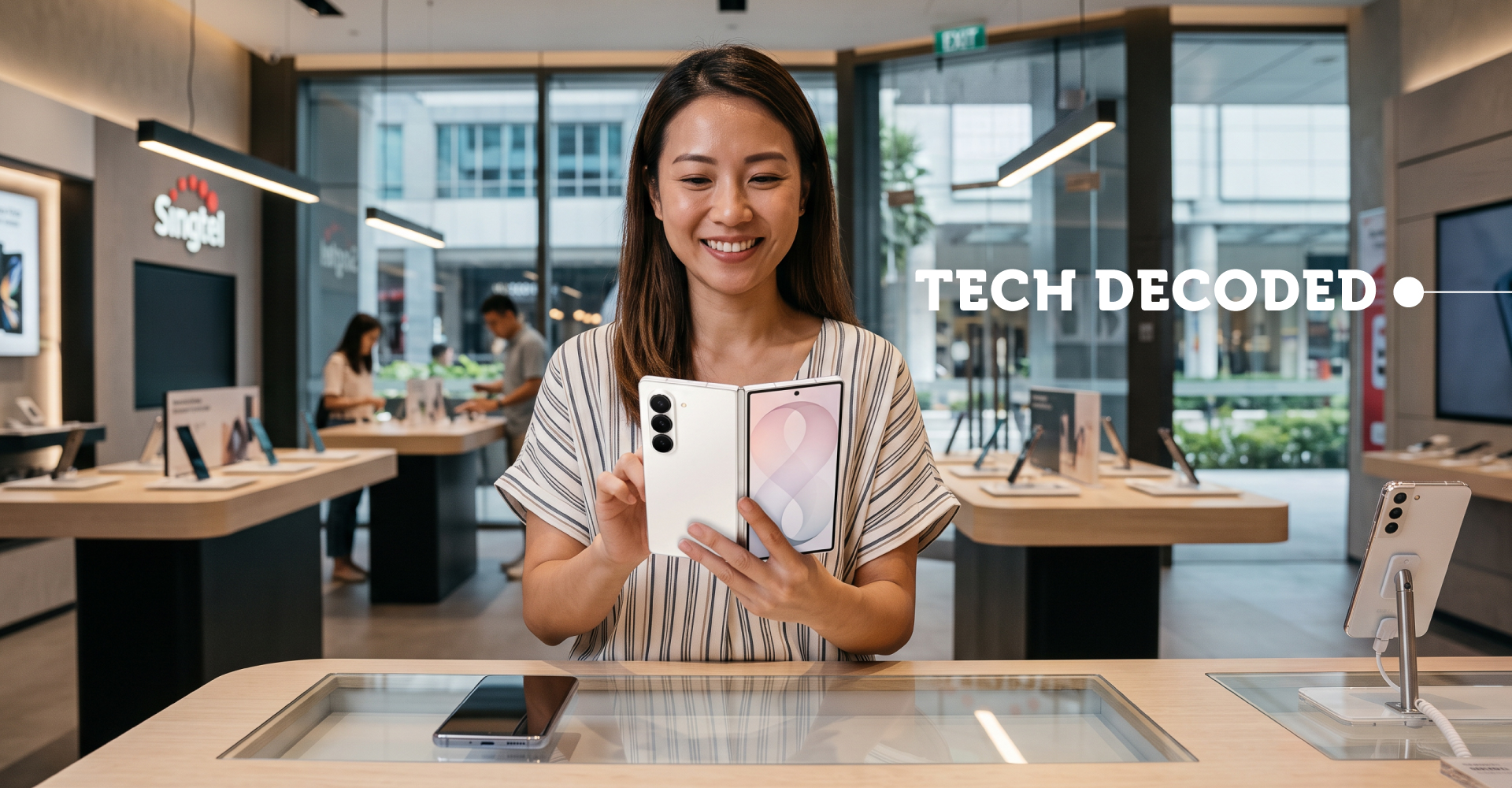
Part of the Tech Decoded guide series by Singtel, helping Singaporeans make smarter tech decisions.
Thinking of making the switch to a foldable phone? The bigger screen and flexible design can be tempting—but they're not necessarily right for everyone.
A foldable phone is worth considering if you regularly use the extra screen space for multitasking, entertainment or work. But if you value simplicity, durability or a wider choice across different budgets, a regular smartphone may still suit you better.
Foldable Phones vs Regular Smartphones: At a Glance
Feature | Foldable Phone | Regualr Smartphones |
|---|---|---|
| Screen size | Compact when closed, larger when opened | Fixed display size |
| Portability | Easier to carry while offering a bigger screen | Simple and familiar |
| Productivity | Excellent for multitasking | Good for everyday use |
| Durability | Improved significantly, but still has moving parts | Proven and robust |
| Repair costs | Usually higher | Generally lower |
| Price | Premium | Available across a wider range of budgets |
You can explore foldable phones at Singtel with a Phone Plan, with an eligible SIM Only Plan, or as a device-only purchase without signing up for a mobile plan.
Samsung foldables offer different experiences depending on what you need. Flip-style models focus on compact portability, while book-style models open into a larger screen designed for multitasking, work and entertainment.
Looking to upgrade your phone without breaking the bank? Singtel’s Trade-In Programme is a smart way to get value from your old device while stepping into the future with a new one.
Why are people choosing foldable phones?
A foldable phone gives you two experiences in one device.
Fold it shut and it slips comfortably into your pocket. Open it up and you have a screen that’s closer to a tablet than a smartphone.
For many users, that means:
Watching Netflix or YouTube on a larger display
Reading documents and emails with less scrolling
Editing presentations while travelling
Running two or three apps side-by-side
Gaming on a more immersive screen
Instead of carrying both a phone and a tablet, a foldable lets you do more with just one device.
Pair Your Foldable Phone with Singtel 5G+
If you’re someone who spends hours on your phone each day, that extra screen space can genuinely change how you work and unwind. A 5G-compatible device can also support faster mobile experiences when used with an eligible plan and suitable network coverage.
Learn more about the Singtel 5G+ network.
Flip vs Fold Phones: Which Is Better for You?
What are the different types of foldable phones?
There are two main types of foldable phones, and they offer quite different experiences.
Book-style foldables
Devices such as Samsung's Galaxy Z Fold series open to reveal a larger, tablet-like inner display.
That extra space can be useful for:
Running apps side by side
Reading documents and emails
Editing presentations
Watching videos
Gaming on a larger display
A book-style foldable may suit you if you want more screen space without carrying a separate small tablet.
Flip-style foldables
Devices such as Samsung's Galaxy Z Flip series take a different approach.
Rather than opening into a tablet-like display, they fold down into a more compact shape when you're not using them.
So, while book-style foldables are largely about more screen, flip-style foldables are largely about more compact portability.
Knowing which benefit matters to you is the first step.
Quick recommendation
Not sure which type of phone suits you? Start here.
If you... | Consider... |
|---|---|
| Regularly multitask across several apps | Book-style foldable |
| Want a larger screen for work, gaming or entertainment | Book-style foldable |
| Want a phone that folds into a more compact shape | Flip-style foldable |
| Prioritise simplicity and durability | Regular smartphone |
| Want the widest choice across different budgets | Regular smartphone |
| Care most about camera performance | Compare individual models rather than form factor alone |
The key idea: don't choose a foldable simply because it's newer. Choose one if the way it folds genuinely makes the things you already do on your phone better.
The biggest concern: Are foldable phones durable enough?
Today’s foldable phones are very different from the first-generation models.
Manufacturers have strengthened hinge designs, improved flexible display materials, and added better water resistance. Many premium foldables are now rated for hundreds of thousands of folds under laboratory testing, making them suitable for years of normal daily use.
That said, foldables still contain moving parts.
Compared to a conventional smartphone, you’ll want to take slightly better care of one by:
Avoiding excessive dust or sand around the hinge
Using a protective case
Not pressing excessively hard on the flexible inner display
Following the manufacturer’s care recommendations
For most people, durability is no longer the deal-breaker it once was—but it is still something to consider if you’re particularly rough on your devices.
Foldable Phones vs Regular Smartphones: Which Lasts Longer?
Regular smartphones still have the advantage when it comes to simplicity and proven durability.
Without a hinge or flexible display, there are simply fewer components that experience repeated mechanical movement.
That makes traditional smartphones:
Easier to maintain
Less expensive to repair
Better suited for users who prioritise longevity over new form factors
If you mainly use your phone for messaging, banking and social media, a regular smartphone remains a practical choice.
From the Singtel team 💡
Try the fold before you make the switch.
Foldables can feel noticeably different from regular smartphones—from their weight and thickness to the hinge and inner display.
If you're unsure, spend some time with one in person. Open it. Close it. Try the apps you use every day. See how it feels in your hand and pocket. You can experience selected foldable and regular smartphones at your nearest Singtel Shop.
Is the Crease on a Foldable Phone Noticeable?
Yes, you can usually see or feel it.
How noticeable it is depends on the phone, lighting and how you use the display. You may see the crease more clearly when the screen is dark or viewed from certain angles. During everyday use, you may find it less distracting—but that's personal.
This is another reason to try a foldable before buying one.
During normal use—whether you’re watching videos, scrolling on social media or replying to messages—most users stop noticing it after a short period.
Like laptop bezels or camera cut-outs, it quickly fades into the background.
If the crease bothers you when you're testing the phone, factor that into your decision rather than assuming you won't notice it later.
Do foldable phones have better cameras?
Not necessarily. Traditional flagship phones often have slightly better camera hardware because they have more internal space for larger sensors and lenses.
Foldable phones, however, have improved dramatically over recent generations.
For most users, both deliver excellent photography for:
Family moments
Food photography
Travel
Night shots
Social media content
Unless you’re a photography enthusiast looking for the absolute best zoom performance or low-light capabilities, camera quality alone probably won’t determine your purchase.
Selected Apple iPhone, Samsung Galaxy, Google Pixel, OPPO, or HUAWEI smartphones offer advanced camera features for everyday photography and content creation regardless if they’re foldable or not.
You will be able to choose how they purchase their new phone (foldable or regular smartphone):
With a Singtel Phone Plan
Pair the device with an eligible Singtel Phone Plan and enjoy the available plan benefits, launch discounts and trade-in offers.
With an eligible SIM Only Plan
Customers who prefer a SIM Only arrangement can purchase the device with an eligible Singtel SIM Only Plan and Singtel PayLater options at launch.
Without a mobile plan
You can also buy the phone on your own from Singtel. You will not need to sign up for or recontract a mobile plan when choosing the device-only purchase option.
The price factor
Foldable phones remain premium devices.
You will usually pay more for a foldable phone than for a regular smartphone with similar specifications.
Before buying, ask yourself:
Will I actually use the larger screen every day?
Am I replacing both my phone and tablet?
Will multitasking make everyday tasks easier?
Does a compact flip design solve a problem for me?
Could a book-style foldable reduce my need for another device?
Is the premium worth the added flexibility?
Am I comfortable with potential repair or production costs?
If the answer is yes, the higher price may be worthwhile.
If not, a regular smartphone could offer better overall value for your needs
Overall purchase cost
Consider the upfront device price together with any recurring payments or mobile charges. The guide to comparing phone prices and total mobile plan costs explains why looking at the overall cost can be more useful than considering only one price.
The final verdict
Foldable phones have come a long way.
They’re more durable, more refined and more practical than the early models that first entered the market. For people who value multitasking, entertainment and productivity, they can genuinely transform the smartphone experience.
Regular smartphone, however, remain the benchmark for reliability, simplicity and value. They continue to deliver outstanding performance for the vast majority of users.
From the Singtel Team 💡
At the end of the day, the best phone isn’t necessarily the one with the biggest screen or the latest design. It’s the one that fits the way you live, work and stay connected on Mobile 5G+
Whether you choose a foldable or a traditional smartphone, understanding your daily needs will help you make the right investment—both for today and for the years ahead.
The bottom line
So, are foldable phones worth it?
For the right person, yes.
A book-style foldable can give you more room for work, watch and multitask. A flip-style foldable can give you a full smartphone experience in a more compact form.
But different doesn't automatically mean better. If simplicity, durability, or value matter more to you, a regular smartphone may still be the smarter choice.
Start with how you use your phone. Then choose the technology that makes those everyday moments easier, more enjoyable or more productive.
And if you're still undecided, come and try both. We'll help you compare your options and find a phone—and a way to stay connected—that fits the way you live.
Frequently Asked Questions
Are foldable phones worth buying?
Yes, if you will regularly use the larger screen, multitasking features or compact folding design. If you prioritise simplicity, durability, or value, a regular smartphone may suit you better.
Are foldable phones durable?
Modern foldable phones are much more durable than earlier generations, but they still have hinges and flexible displays that benefit from extra care.
Is the crease on a foldable phone noticeable?
Usually, yes. How noticeable it feels depends on the model, lighting and viewing angle, so it is worth trying a foldable in person before buying.
Are foldable phones more expensive to repair?
They can be. Flexible displays and hinge mechanisms are more specialised than conventional smartphone components, so repair costs may be higher depending on the model and damage.
Are foldable phones better than regular smartphones?
Not for everyone. Foldables are better for users who value extra screen space or compact portability, while regular smartphones remain strong choices for simplicity, durability and a wider range of prices.
Should I choose a flip-style or book-style foldable?
Choose a flip-style foldable if compact portability matters most. Choose a book-style foldable if you want a larger screen for multitasking, entertainment, or productivity.
Explore smartphones at Singtel
Explore more Tech Decoded guides.
Talk to us →
Chat with us: help.singtel.com/chat
Call us at 1688 (8:30am-6:00pm daily)
Singtel Editorial | 25 August 2026